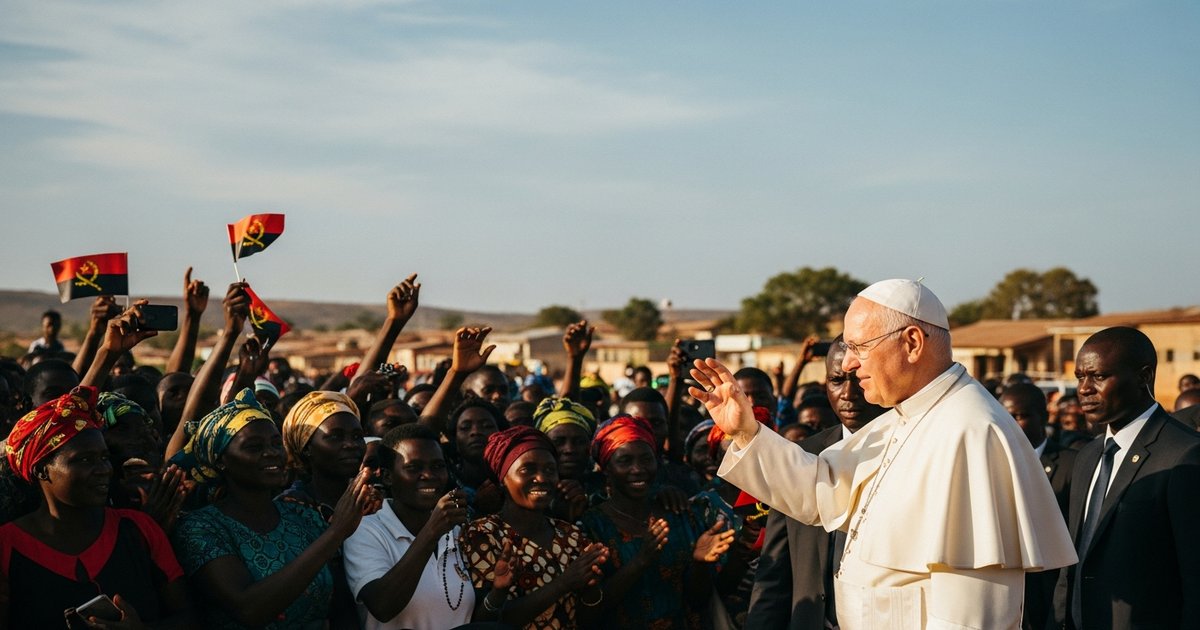
Pope Leo XIV is currently in Angola, having arrived on Saturday, April 18, 2026, and has publicly clarified that his recent message calling for peace was not triggered by comments made by US President Donald Trump. The Pontiff, now on the third leg of an important four-nation trip through Africa, addressed interpretations of his earlier speech, which some had linked directly to the American president. He firmly stated that his remarks advocating for global tranquility were meticulously prepared well in advance of any such public interactions, underscoring the independent and deliberate nature of his diplomatic pronouncements.
Pope Leo XIV's Angolan Mission: A Crucial Stop on an 11-Day Tour
Angola marks a significant stop in Pope Leo XIV's comprehensive 11-day itinerary across the African continent. His Holiness arrived in the Southern African nation on Saturday, April 18, 2026, commencing a visit that is scheduled to span four days, concluding on April 21, 2026. This leg represents the penultimate stage of his arduous journey, a testament to the Vatican's enduring commitment to engaging with diverse communities across the globe. During his time in Angola, the Pope is expected to continue his consistent message of unity and compassion, further solidifying the themes that have defined his entire African pilgrimage.
Upon his departure from Angola, Pope Leo XIV will embark on the final segment of his tour, traveling to Equatorial Guinea. His visit there is slated from April 21 to April 23, 2026, marking the conclusion of an extensive period of engagement and spiritual leadership. This carefully planned route, encompassing four distinct nations, highlights the expansive reach of the Holy See and the Pope's personal dedication to addressing global challenges and fostering interfaith dialogue on the ground.
The Genesis of a Peace Message and its Interpretation
The clarification issued by Pope Leo XIV regarding his peace message directly addresses the commentary that arose following a significant speech he delivered on April 16, 2026. This pivotal address took place in Bamenda, Cameroon, during the earlier stages of his African tour. In Bamenda, the Pope made a profound and heartfelt appeal for peace, articulating a vision for global harmony and mutual understanding. The gravity and universality of his words resonated widely, but also led to varied interpretations.
Notably, segments of the media and public opinion began to draw connections between the Pope's powerful call for peace and recent statements by US President Donald Trump. This speculation suggested that the Pontiff's remarks were, implicitly or explicitly, a response or critique directed at the American leader. Such interpretations, while indicative of the intense scrutiny surrounding papal pronouncements, prompted the Holy See to provide direct context to prevent misunderstandings and to ensure the true intent of the message was preserved.
Pope Leo XIV's Direct Clarification: Prior Preparation, Not Reaction
In response to these interpretations, Pope Leo XIV issued a clear and unequivocal statement to set the record straight. He directly pushed back on the notion that his peace message was a reaction to any specific political figure or event. The Pontiff emphasized that his remarks were the product of careful consideration and planning, revealing that they had been written a full two weeks prior to their delivery. This timeline is crucial, as it predates any related public comments by President Trump regarding the Pope or the broader message of peace.
"My remarks had been written two weeks prior, well before the president ever commented on myself and on the message of peace that I am promoting."
This explicit statement serves to underscore the independent nature of the Pope's spiritual and diplomatic initiatives. It reinforces the idea that his calls for peace are not ad hoc responses to transient political developments, but rather deeply considered appeals stemming from core theological and humanitarian principles. The clarity of his denial aims to redirect focus from speculative political interpretations back to the universal and enduring message of peace that forms the bedrock of his papacy and this entire African tour.
An Enduring Message: Peace as a Global Moral Responsibility
Throughout his demanding 11-day journey across Africa, Pope Leo XIV has consistently championed the overarching theme of peace, framing it not merely as a desirable outcome but as a profound global moral responsibility. This unwavering emphasis highlights a central pillar of his pontificate, signaling a deep-seated belief that fostering harmony is a shared duty incumbent upon all individuals and nations. His recurring themes, articulated in every stop, include the urgent need for everyone, irrespective of their background, beliefs, or political allegiances, to unequivocally reject violence in all its insidious forms. He has stressed that this rejection is not a passive stance, but an active commitment requiring continuous effort and vigilance.
Furthermore, the Pontiff has continuously called for a collective and diligent commitment to working toward justice. He consistently articulates that true, lasting peace cannot genuinely exist without justice, linking the two concepts as inseparable and interdependent components of a stable, ethical, and compassionate global society. His addresses, from Bamenda to Angola, have consistently echoed these foundational principles, urging both world leaders and ordinary citizens alike to actively engage in the challenging but essential work of building equitable systems, resolving grievances through peaceful means, and fostering environments where dignity and human rights are universally upheld. This sustained focus on justice as an indispensable prerequisite for peace reflects a comprehensive and holistic vision for global stability, one that transcends immediate political headlines and seeks to address the fundamental root causes of conflict and suffering. The Pope's message remains clear: peace is not a temporary cease-fire, but a continuous, active pursuit rooted in shared moral duty and the unwavering quest for justice for all.