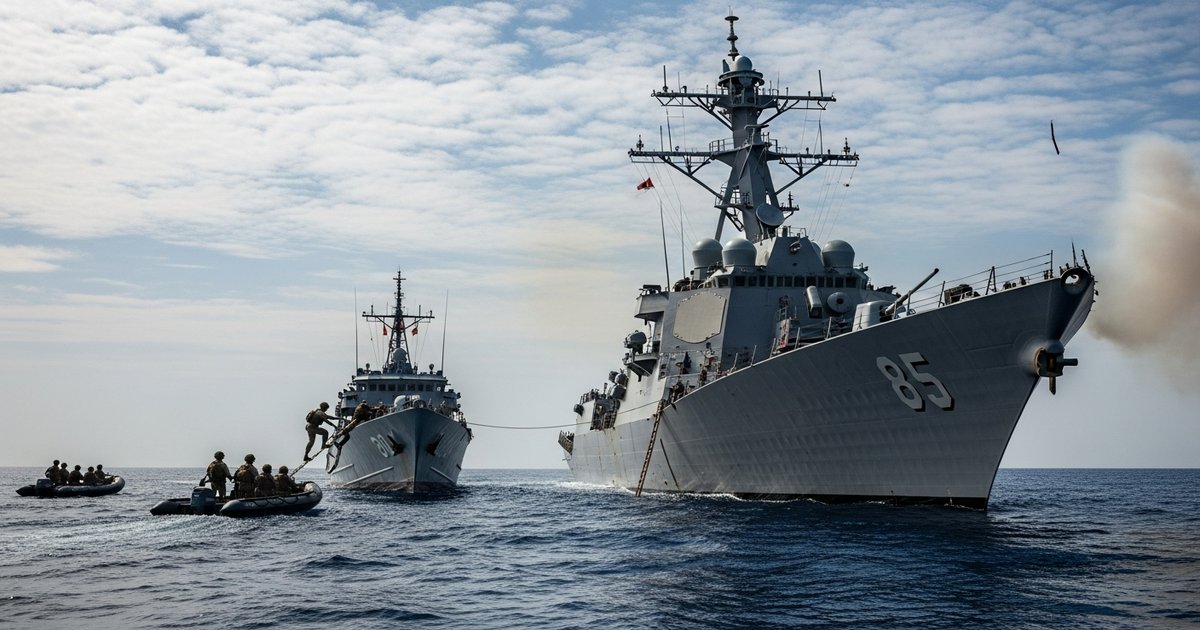
On Sunday, April 19, 2026, a U.S. Navy guided-missile destroyer, the USS Spruance, engaged and fired upon an Iranian-flagged cargo ship named Touska in the Gulf of Oman. U.S. Marines subsequently boarded and took custody of the vessel after the Iranian ship refused to comply with warnings over approximately six hours, leading the U.S. Navy to disable its propulsion system. This significant maritime incident unfolds amidst a fragile ceasefire between the U.S. and Iran, raising immediate concerns about regional stability and the future of diplomatic efforts.
Details of the Engagement in the Gulf of Oman
The confrontation began when the USS Spruance intercepted the Iranian-flagged cargo ship Touska. According to U.S. military reports, the Iranian vessel refused to comply with U.S. warnings for an extended period, approximately six hours. Faced with non-compliance, the U.S. Navy took decisive action. The USS Spruance fired several rounds from its 5-inch MK 45 gun, targeting Touska's engine room to disable its propulsion system. Following the successful disabling of the ship, U.S. Marines boarded Touska and assumed control of the vessel, taking custody of the ship and its crew.
President Donald Trump confirmed the incident, offering a U.S. justification for the aggressive measures. Trump stated that Touska was under U.S. Treasury Sanctions, citing its prior history of illegal activity. This background, according to the U.S. administration, contributed to the decision to intercept and ultimately disable the ship.
Regional Tensions Heighten Amidst Ceasefire
The incident in the Gulf of Oman on April 19, 2026, carries profound implications, occurring as it did during a delicate ceasefire agreed between the U.S. and Iran just days earlier, on April 7-8, 2026. This maritime confrontation immediately casts a shadow over the prospects for lasting peace and stability in the region.
Iran's reaction to the U.S. actions has been swift and severe. An Iranian military spokesperson issued a stark warning, stating, 'We warn that the armed forces of the Islamic Republic of Iran will soon respond and retaliate against this armed piracy by the U.S. military.' Iran has publicly characterized the boarding of Touska as 'armed piracy' and has asserted that the U.S. firing on the vessel constitutes a clear breach of the recently agreed ceasefire. These statements indicate a potentially dangerous escalation in the ongoing tensions between the two nations.
"We warn that the armed forces of the Islamic Republic of Iran will soon respond and retaliate against this armed piracy by the U.S. military." - Iranian military spokesperson.
The broader geopolitical context further complicates the situation. The incident occurred in parallel with the continued U.S. naval blockade of Iranian ports, a measure that was imposed after the first round of U.S.-Iran peace talks in Islamabad collapsed. This ongoing blockade, combined with Sunday's events, paints a picture of persistent pressure and military posturing that undercuts diplomatic overtures.
Diplomatic Efforts Face New Hurdles
Despite the escalation, diplomatic efforts are ostensibly still in motion, albeit on a precarious footing. Also on April 19, 2026, President Trump announced that a U.S. delegation would travel to Pakistan for a second round of talks. This delegation is expected to comprise Vice President JD Vance, special envoy Steve Witkoff, and Jared Kushner. However, Tehran quickly countered this announcement, stating that it had not agreed to attend any such talks. This disconnect highlights the significant challenges facing any future peace negotiations and underscores the deep mistrust that persists between the two sides.
The interception and firing upon the Touska, followed by the boarding by U.S. Marines, represents a critical flashpoint. Coming just days after a ceasefire agreement and in the shadow of ongoing blockades and stalled peace talks, this incident has dramatically raised the stakes in the U.S.-Iran relationship. The world watches to see how Iran will respond to what it calls an act of 'armed piracy' and how this will impact the already fragile situation in the Gulf region.