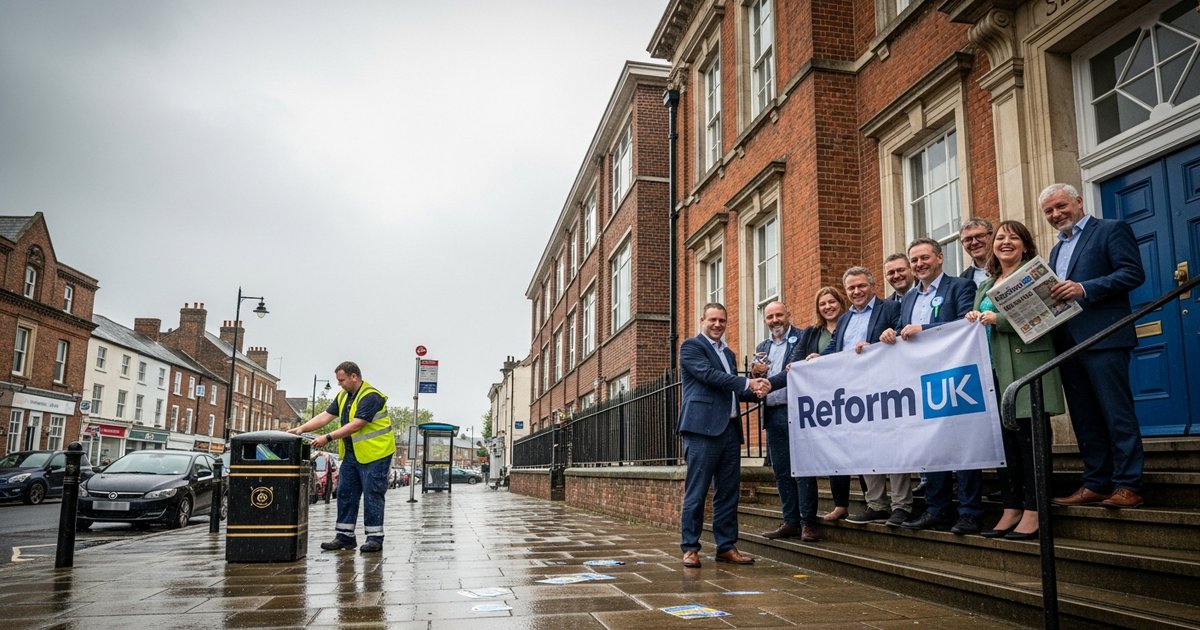
On the night of 7 May 2026, Reform UK swept large parts of the eastern English shires. Twenty-two seats taken on Dudley Council. Twenty-eight of the first 43 Essex County Council divisions to declare. District-level wins in Basildon, Brentwood, Rochford and Southend. Three eastern county councils, Essex along with Norfolk and Suffolk, are projected to flip into Reform control. Labour is projected to lose Wigan, plus Sunderland and Barnsley. The political map of England has visibly shifted, and the question every household in those areas is now asking is what that means for the council tax bill, the social care visit, the school place, and the road that needs repaving.
The short answer: county councils control a significant share of household-impact services, and Reform UK has not yet published a council-level policy programme. The longer answer follows, with the powers a council actually has, what is locked by central government, and what could realistically change.
Who won the 7 May 2026 UK local elections?
Reform UK was the night's clear gainer. The Conservatives and Labour both lost ground across multiple authority types, with the eastern counties and the Black Country showing the sharpest swings. Specific declared results worth holding in your head:
- Dudley Council: Reform UK won 22 seats and is now the second largest party with 23 seats overall. The Conservatives remained the largest party with 27 seats, down from 33 before the elections.
- Essex County Council: 43 of the 78 electoral divisions had declared overnight. Reform UK won 28 of those 43 declared divisions.
- Reform UK district-council wins in Essex include 11 seats in Basildon, 5 in Brentwood, 13 of 15 available in Rochford, and 7 in Southend.
- Labour is projected to lose control of Wigan, plus Sunderland and Barnsley.
Which councils did Reform UK take control of in May 2026?
Reform UK is projected to take control of three eastern English county councils: Essex, plus Norfolk and Suffolk. Full county results were still being declared at the time of writing; the projections are based on the early declared divisions. Reform UK is also significantly larger on Dudley Council and across multiple district councils in Essex, even where it has not taken outright control.
The phrase 'projected to take control' carries weight here. A council does not formally change leadership the night the votes are counted. The new council convenes and elects its leader at the annual meeting in May. The political composition decides who chairs which committee and who sets the agenda. The mechanics matter because they determine when any policy change actually takes effect.
What is the difference between a county council and a district council?
The two types of council have different powers, and a household sees both on its council tax bill.
County councils run adult social care, children's social care, education for non-academy schools, public libraries, road maintenance, and waste disposal. The county precept is one component of the household council tax bill.
District councils run planning, refuse collection, housing benefit administration, and environmental health. District councils, by contrast, set the headline council tax rate. The district precept is the other main component of the household total.
If Reform UK takes Essex County Council, the policies that change first are county-level: social care commissioning, library hours, and road repair priorities. The headline council tax bill is set by Reform-influenced district councils where Reform now sits with significant numbers (Basildon, Brentwood, Rochford, Southend), and by other-party district councils where it does not.
Are there limits on how much a council can raise council tax?
Yes, and the limits are tight. Central government caps council tax increases. A council tax rise above the cap requires a local referendum, which historically councils have not won. For upper-tier authorities (the type that includes county councils) the cap is set at a 2 per cent base increase plus a 3 per cent adult social care precept; any increase above 4.99 per cent triggers a referendum. District councils have a separate, lower cap.
What this means for a Reform-controlled county council: the council can choose to raise council tax up to the cap, hold it flat, or cut it. It cannot raise above the cap without a referendum. The lever a Reform council has on the household bill is therefore real but constrained, and the bigger lever is on services: where the budget gets spent, not how much is raised.
What does a Reform UK council mean for adult social care?
Adult social care is the largest single line in a county council's budget. Most councils spend between 35 and 50 per cent of their net budget on it.
Reform UK has not published a specific adult social care policy at council level. The party's national-level positions cited at council level call for tightening service eligibility and reviewing local authority spending priorities. What that translates into at council level depends on which Reform leader is elected to run each council and what coalition arrangement (if any) they need to govern.
For a household with an elderly parent receiving social care, the practical implication is continuity in the short term while the new council audits its inherited budget and commissions its review. Material change comes later, if it comes at all, and is constrained by the statutory duty of care under the Care Act 2014, which a Reform council inherits intact.
What does a Reform UK council mean for schools?
Most secondary schools in Essex, Norfolk and Suffolk are academies, which are funded directly by central government and are not under local authority control. The county council role on schools centres on non-academy primary schools and on special educational needs (SEND) provision.
The lever a Reform council has on schools is therefore narrow but real. SEND budgets across English county councils have produced significant overspends, with a central-government statutory override allowing the related deficits to be held off the General Fund balance sheet temporarily. A new Reform-led council inherits the SEND financial position from its predecessor on day one and has to make the same arithmetic decisions.
Will my council tax change because Reform UK won?
Probably not in 2026-27. Council tax bills for the 2026-27 financial year were set in February 2026, before the election. The earliest a new Reform-led council can change the bill is the 2027-28 setting, decided in February 2027.
For 2027-28, three scenarios sit on the table. A Reform council could raise council tax up to the maximum allowed without triggering a referendum (the 2 per cent base plus 3 per cent adult social care precept for upper-tier authorities), citing the inherited social care pressure as the reason. It could hold flat, citing voter expectations and accepting service cuts to balance the budget. It could cut, which would require deeper service reductions to offset the lost revenue and would be the most politically visible choice. Where Reform UK lands on this is a question the party has not answered publicly, and is one of the first material policy decisions each newly-controlled council will face.
Frequently asked questions
Who won the 7 May 2026 UK local elections?
Reform UK was the night's main gainer, taking 22 seats on Dudley Council and 28 of the first 43 declared divisions on Essex County Council, plus district-council seats in Basildon, Brentwood, Rochford and Southend. Both the Conservatives and Labour suffered losses across multiple authority types.
Which councils did Reform UK take control of in May 2026?
Reform UK is projected to take control of three eastern English county councils: Essex, plus Norfolk and Suffolk. Full county results were still being declared at the time of writing. Reform UK has also become a significantly larger force on Dudley Council and across multiple Essex district councils.
How many seats did Reform UK win in Essex County Council?
Of the 78 electoral divisions on Essex County Council, 43 had declared overnight after the 7 May 2026 elections, with Reform UK winning 28 of those declared divisions. The remaining 35 divisions were still to declare at the time of writing.
How many seats did Reform UK win on Dudley Council?
Reform UK won 22 seats on Dudley Council in the 7 May 2026 elections. The party is now the second largest on the council with 23 seats overall. The Conservatives retained the council with 27 seats, down from 33 before the elections.
Will my council tax change because Reform UK won?
Council tax for 2026-27 was set in February 2026, before the election, and will not change. A new Reform-led council can choose to raise, hold or cut council tax for 2027-28, set in February 2027. Any rise above the maximum allowed for upper-tier authorities (2 per cent base plus 3 per cent adult social care precept) requires a local referendum.
What does a Reform UK council mean for adult social care?
Reform UK has not published specific adult social care policy at council level. Adult social care is typically 35 to 50 per cent of a county council's net budget and is a statutory duty under the Care Act 2014, which any new Reform council inherits intact. Material change to provision is unlikely in the first six to nine months while the new council audits its budget.
What does a Reform UK council mean for schools?
Most secondary schools in the affected counties are academies, which are funded directly by central government and not under local authority control. A Reform-led council's school-related powers cover non-academy primary schools and special educational needs (SEND) provision. SEND budgets are under acute pressure across English county councils, with most running deficits offset by a temporary central-government statutory override.
What is the difference between a county council and a district council?
County councils run adult social care, children's social care, education for non-academy schools, libraries, road maintenance, and waste disposal. District councils run planning, refuse collection, housing benefit administration, and environmental health, plus they set the headline council tax bill. A household pays a precept to both.
Are there limits on how much a council can raise council tax?
Yes. The current cap for upper-tier authorities (county councils) is a 2 per cent base increase plus a 3 per cent adult social care precept; any increase above 4.99 per cent triggers a local referendum. District councils have a separate, lower cap. Any rise above the cap requires a local referendum, which historically councils have rarely won.