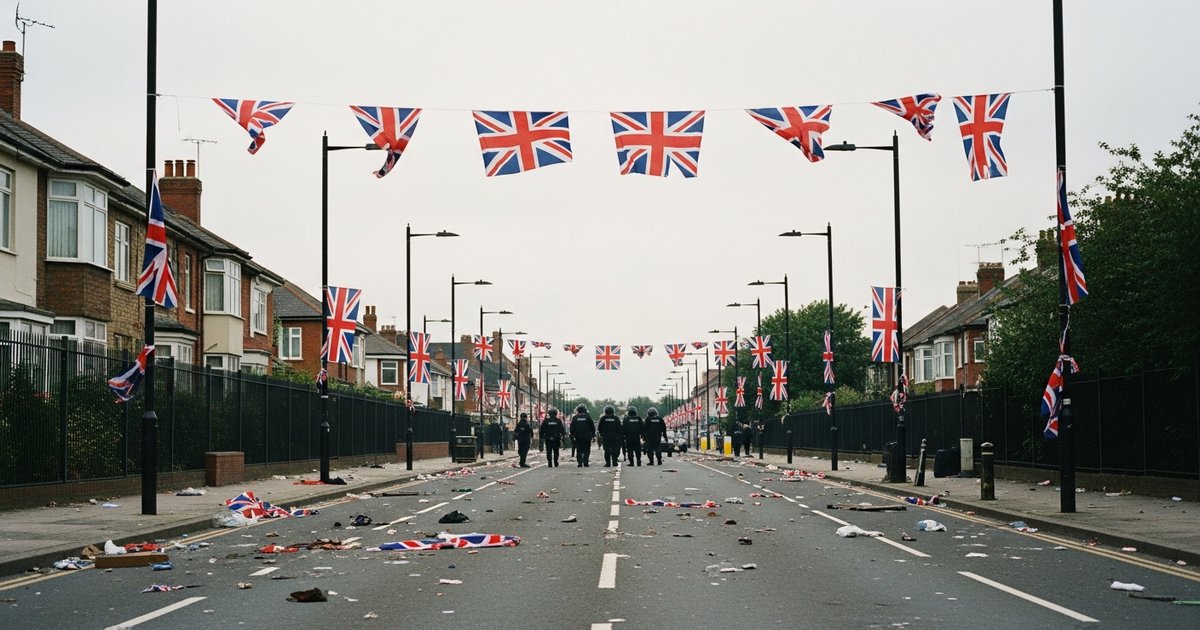
Between July 2024 and May 2026, the UK experienced a continuous far-right mobilisation that followed a consistent operational pattern: a mainstream-adjacent mass rally establishing an audience, followed by a triggering event, rapid social media amplification of false claims, widespread street violence, and the consolidation of rhetorical infrastructure through normalised activities like flag campaigns, culminating in larger subsequent rallies. This pattern is evident in the progression from the 27 July 2024 'Unite the Kingdom' rally to the May 2026 follow-up rally, which drew approximately 60,000 attendees according to police estimates, demonstrating a two-year pipeline of increasing activity.
What initiated the 2024 far-right mobilisation?
The sequence of events began with the 'Unite the Kingdom' rally in central London on 27 July 2024. Organised in the orbit of far-right activist Tommy Robinson (Stephen Yaxley-Lennon), the event marched from the Royal Courts of Justice to Trafalgar Square. Speakers included actor Laurence Fox, former UKIP candidate Carl Benjamin, and former Conservative MP Andrew Bridgen. Independent monitoring organisation HopeNotHate described this gathering as one of the largest far-right street mobilisations in the UK in recent decades.
Two days later, on 29 July 2024, a triggering event occurred in Southport, Merseyside. Three children. Bebe King, 6; Elsie Dot Stancombe, 7; and Alice Dasilva Aguiar, 9. were stabbed and killed at a dance class. The attacker, Axel Rudakubana, was a UK-born son of Rwandan Christian refugees. He was not Muslim and not an asylum seeker, despite false claims to that effect that spread rapidly on social media.
How did false claims about Southport amplify unrest?
The Southport stabbings immediately became a focal point for misinformation. In the two weeks following the attack, Tommy Robinson's posts on X received over 580 million views, according to Amnesty International's analysis of platform amplification. Robinson had approximately 840,000 X followers at the time. The Royal United Services Institute (RUSI) identified networks linked to Russian-state-aligned accounts as early boosters of these false claims regarding the attacker's identity, religion and immigration status.
The rapid spread of these false claims contributed to the outbreak of coordinated street violence. Between 30 July and 7 August 2024, an estimated 29 anti-immigration demonstrations and riots took place across 27 UK towns and cities, as documented by the House of Commons Library policing-response briefing. This included incidents in London, Manchester, Hartlepool and Aldershot on 31 July; Belfast on 3 August; Rotherham, Bolton, Middlesbrough, Tamworth, Solihull, Hull, Weymouth and Sheffield on 4 August; and Plymouth, Belfast and Darlington on 5 August.
On 30 July 2024, a demonstration outside the Southport Islamic Society Mosque turned violent. Hundreds of masked men threw bricks, plant pots, and bins at the mosque and at riot police, injuring more than 50 officers and setting a police van on fire. Two individuals, Lucy Connolly (41, Northampton) and Tyler James Kay (26), were later convicted for inciting racial hatred through social media posts following the stabbings, receiving sentences of 31 months and 38 months respectively. Connolly's appeal was rejected by the Court of Appeal in May 2025, after her post was viewed 310,000 times.
What was the scale of the 2024 UK riots and their consequences?
The violence escalated significantly during the August 2024 riots. On 4 August 2024, a mob attacked the Holiday Inn Express in Manvers, Rotherham, which was housing asylum seekers. Attackers threw concrete blocks, chairs, fire extinguishers, and tree branches at police. They smashed windows and pushed a burning bin filled with flammable material against a fire door in an attempt to set the building alight. Over 200 asylum seekers were trapped on the upper floors. South Yorkshire Police reported 51 officers injured, alongside police dogs and horses.
More than 70 men have been jailed for their roles in the Rotherham Holiday Inn Express attack alone, according to Crown Prosecution Service announcements. Thomas Birley, 27, of Swinton, received a nine-year sentence after pleading guilty to arson with intent to endanger life, violent disorder, and possession of an offensive weapon for pushing the burning bin and stoking the fire. Levi Fishlock, 31, of Barnsley, also received nine years for similar charges, adding planks of wood to the fire. Arron Bailey, 28, and Morgan Heeley, 26, both of Darfield, were each sentenced to eight years for violent disorder and arson with intent to endanger life. These nine-year sentences are the joint-longest handed down for offences during the 2024 disorder.
Other significant convictions included Derek Drummond, 58, sentenced to three years for violent disorder and assaulting an emergency worker; Liam Riley, 41, sentenced to 20 months for violent disorder; and Derek Geiran, 29, sentenced to two-and-a-half years for violent disorder. On 31 July 2024, the Potters International Hotel in Aldershot, also housing asylum seekers, was attacked. A 13-year-old girl later pleaded guilty to violent disorder for kicking and punching the hotel entrance.
The broader impact included hundreds of UK mosques tightening security, and the Muslim community reporting 'anxiety and fear' through the disorder and its aftermath, according to independent reporting by Hyphen, Amnesty International, and Middle East Eye. As of 30 August 2024, UK police had made 1,280 arrests related to the riots, with 796 people charged. By July 2025, these figures had risen to 1,840 arrests and 1,103 charges. By 8 August 2024, 177 people had been imprisoned, with sentences averaging around two years and ranging up to nine years. Insurance Journal estimated in August 2024 that insured property losses from the riots were below £250 million.
How did 'Operation Raise the Colours' normalise far-right rhetoric?
Following the immediate street violence, the rhetorical infrastructure of far-right mobilisation continued to consolidate. 'Operation Raise the Colours', a campaign movement, emerged in August 2025. It involved groups displaying the Union Flag and the Saint George's Cross in public places. Independent monitoring organisation HopeNotHate identified Tommy Robinson, the Britain First political party (led by Paul Golding), and other senior UK far-right activists as supporters and promoters of this campaign.
Nick Ireland, the Liberal Democrat leader of Dorset Council, publicly stated in August 2025 that the campaign had been 'hijacked' by the far-right. He warned that flag displays were intimidating residents through their far-right association. Multiple UK and international monitoring outlets, including HopeNotHate, NBC News, Christian Science Monitor, Hyphen and The Bureau of Investigative Journalism, reported in 2025 that many Operation Raise the Colours flag clusters appeared in close proximity to hotels housing asylum seekers, effectively transforming flag displays into territorial markers.
Did far-right street mobilisation grow by 2026?
The progression of this pipeline culminated in a follow-up 'Unite the Kingdom' rally in central London in May 2026. This event, estimated by the London Metropolitan Police to have drawn approximately 60,000 attendees, marked it as one of the largest single far-right or right-wing-aligned street mobilisations in recent UK history. HopeNotHate has documented continuity of organisation, named speakers, supporters as well as reported financing across the 27 July 2024 'Unite the Kingdom' rally, the August 2025 'Operation Raise the Colours' campaign, and the May 2026 follow-up rally. This continuous growth across two years illustrates a pattern of escalating far-right activity in the UK.
What should you do next?
Understanding the documented pipeline of far-right mobilisation, from initial rallies and triggering events to social media amplification, widespread violence, and subsequent rhetorical consolidation, offers insight into its recurring nature. Monitoring organisations like HopeNotHate continue to track these developments and provide public analysis. Stay informed through verified sources and official police and court records to understand the documented scale and consequences of such events.