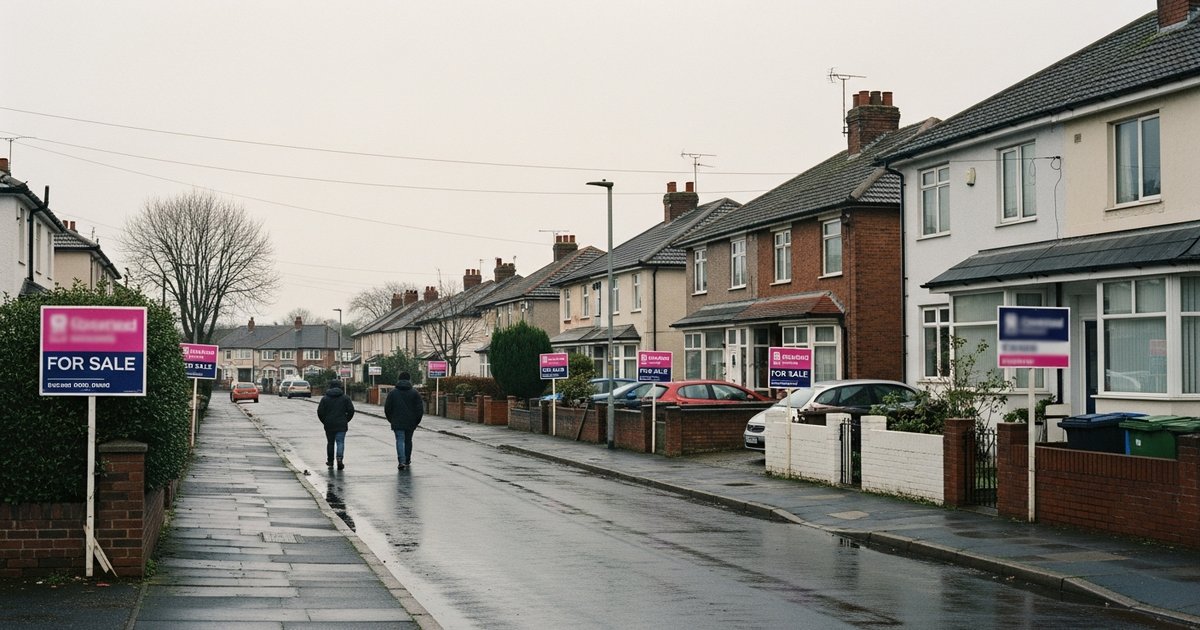
UK house prices recorded their first monthly fall this year in May 2026, declining by 0.6 per cent, according to the latest House Price Index published by Nationwide Building Society on 1 June 2026. Annual house price growth also decelerated sharply to 1.7 per cent, a notable drop from 3.0 per cent in April 2026. This represents the weakest monthly Nationwide print since the significant mortgage-rate shock experienced in 2022 and 2023.
What are the latest UK house price figures?
The 0.6 per cent month-on-month fall in May reflects a shift in market conditions, particularly when compared to earlier in the year. Nationwide's Chief Economist, Robert Gardner, confirmed this trend, noting that the index primarily tracks owner-occupier house purchase transactions involving a mortgage with Nationwide, excluding buy-to-let and cash purchases.
Separate data corroborates a cooling market. Halifax's UK House Price Index for April 2026 reported an average UK house price of 299,313 pounds, with a 0.1 per cent monthly fall. Halifax attributed this decline in part to higher borrowing costs and lower consumer confidence, linking these factors to the US-Iran conflict. The Royal Institution of Chartered Surveyors (RICS) UK house price balance for April 2026 further underscored this weakening sentiment, recording negative 34, down from negative 25 in March, marking its weakest reading since November 2023.
How is the Iran war impacting UK mortgage rates?
The recent slowdown coincides with a sharp rise in UK mortgage rates over April and May. This increase has been driven principally by the US-Iran conflict and the associated rise in global oil prices. Global investors have responded by pricing in higher-for-longer inflation risk, which in turn has pushed UK gilt yields materially higher over this period.
UK fixed mortgage rates are priced primarily off interest-rate swap rates, which closely track these UK gilt yields. As a direct consequence, the average UK two-year fixed mortgage rate stood at 5.73 per cent as of 28 May 2026, up approximately 90 basis points from 4.83 per cent at the start of March 2026, a move in under three months. The Bank of England Bank Rate stood at 4.25 per cent as of late May 2026, but fixed mortgage rates have risen independently of Bank Rate due to inflation-risk pricing in swap markets.
What do higher mortgage rates mean for homeowners?
The Times reported on 31 May 2026 that UK house prices are now forecast to fall by approximately 2 per cent over the remainder of 2026. This projection cites the Iran war and the associated rise in UK mortgage rates as the principal driver. A 2 per cent fall in UK house prices, when applied to the Halifax April 2026 average of 299,313 pounds, would equate to approximately 5,986 pounds of lost paper wealth per average home.
For mortgage holders, the impact of rising rates is direct. On a 200,000 pound, 25-year mortgage, a shift from 4.83 per cent to 5.73 per cent increases the monthly payment by approximately 109 pounds. This translates to about 1,300 pounds per year in additional costs. Industry estimates, summarised by HomeOwners Alliance, indicate that approximately 1.6 million UK households are coming to the end of a fixed-rate mortgage between May 2026 and the end of 2027. These households will face this higher rate environment when they remortgage.
What should UK mortgage holders be aware of?
Despite the general rise in rates, several large UK lenders, including Nationwide, HSBC, Santander, Halifax, and TSB, announced some fixed-rate cuts in late May 2026. While these adjustments offer some relief, the new rates remain materially above the levels seen at the start of March. Homeowners approaching the end of their current fixed-rate terms will need to assess these prevailing market conditions and their potential impact on future mortgage payments.