The Football Desk | The Breakdown
UPDATE, 8 August: done, in everything but the club statement. The fee was agreed on Wednesday at £75m, per Sky Sports, with performance add-ons reported on top — The Times had put the full package at around £80m. Bruno passed his medical and signed a four-year contract on Thursday night, per Fabrizio Romano. And on Friday the Newcastle boardroom said what the statement has not: sporting director Ross Wilson revealed Bruno had 'effectively told us he wanted to leave and move on', while chief executive David Hopkinson named the destination plainly: 'Arsenal are getting a very special player and person.' No official announcement from either club at the time of writing, so the desk's law technically holds — but the analysis below, published on 31 July while this was still a bid, now reads as a preview of a real midfield. For what the sale means at the other end, the desk has broken down what Newcastle do now.
UPDATE, 1 August: overnight, multiple outlets report Arsenal and Newcastle have reached agreement: a base fee around €90m plus bonuses, a five-year contract, medical pending. Not yet announced by either club, and the desk's law stands until it is. The analysis below was published on 31 July, before the agreement, and is left as written. Note the final section's sequencing tell: Newcastle are already reported to be in talks for an Arsenal player.
Arsenal have put a reported £80 million on the table for Bruno Guimarães, against a Newcastle ask of £85m, with personal terms said to be agreed and a decision expected around his return to pre-season. Nothing is done until it is announced; that is the desk's standing law. But a transfer bid is never just a bid. It is a confession of what the buyer believes they lack. Read this one carefully and it tells you Arteta's entire midfield plan.
Start with where Bruno has actually played
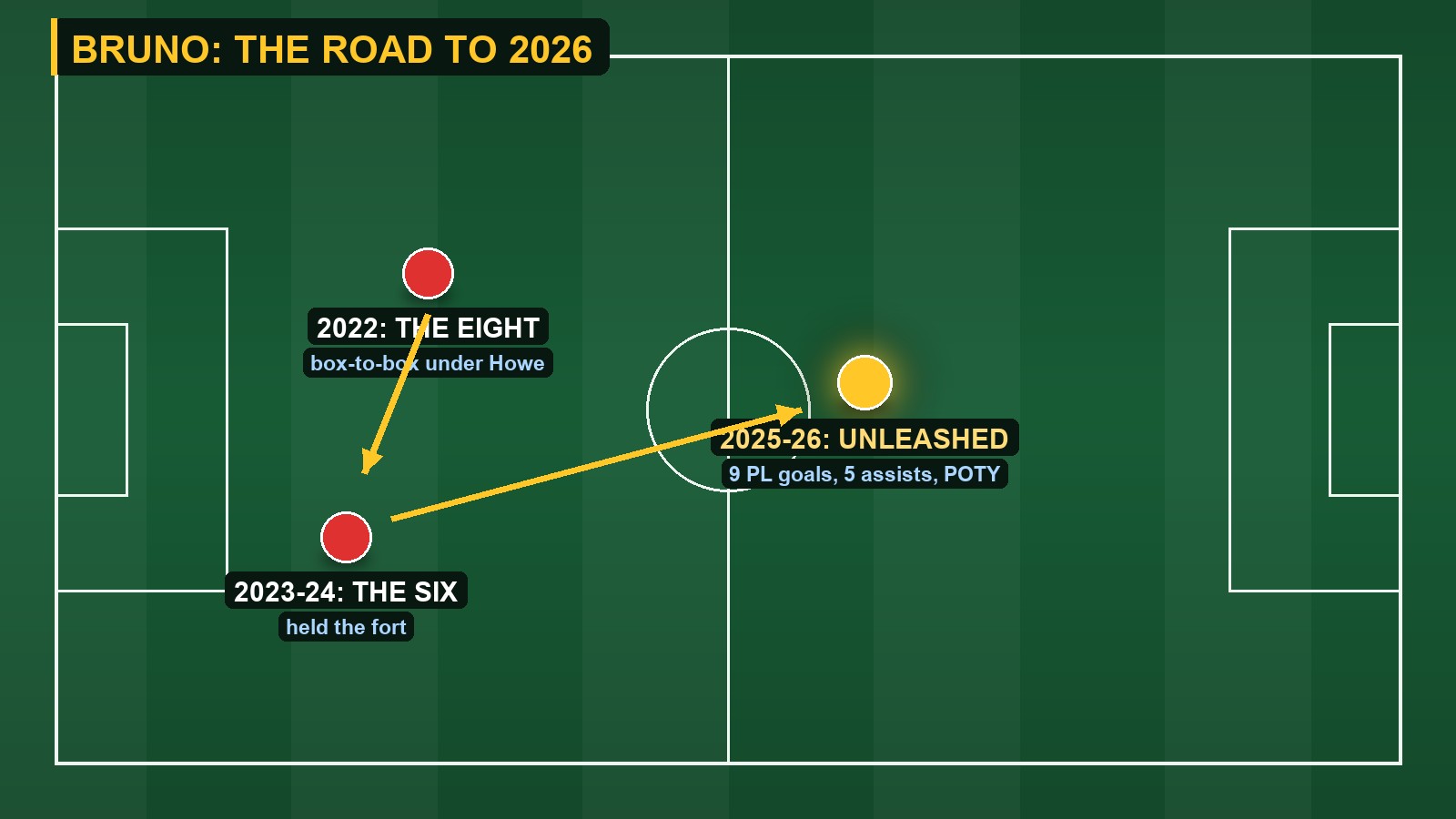
Bruno arrived at Newcastle in January 2022 as an eight, a box-to-box carrier with a Lyon education. Squad necessity then dragged him backwards: for the best part of two seasons he was the six, holding the fort, the deepest man in Howe's midfield, doing honest work a level below his talent. Last season Howe finally released him forward again, and the answer was emphatic: 9 Premier League goals and 5 assists in 29 league games, a hamstring costing him two months of more, the captaincy, and Newcastle's Player of the Year award. Five seasons of evidence say he can hold any of the three central posts at an elite level. The last one says the advanced version is the best version. Hold that thought.
Now look at the midfield he would join
First, the machine and its parts, because the names matter. Zubimendi is the six, the metronome at the base. Rice is the left-eight, the power that arrives in boxes. Odegaard is the ten, the brain, with Eze as his deputy. Merino is the utility man off the bench. And by the season's end the midfield had a fifth member: Myles Lewis-Skelly, twenty league starts at nineteen, the Hale End central midfielder who began the era listed at left-back and finished it in midfield proper — starting the Champions League final in a two-man pivot beside Rice. That is the machine that won the league and, in Budapest on penalties, lost the Champions League final to Paris Saint-Germain. Now watch what happened inside it.
On paper, Arsenal's title-winning midfield needs nothing. Zubimendi arrived for £51m and made the six his own: 1,684 Premier League minutes by early January, over a thousand completed passes at 89.4%, and performances like his 8.3-rated dismantling of Aston Villa that had analysts calling him the tempo of the champions. His arrival freed Rice into the left-eight, where he stopped being the security guard and started arriving in boxes: four league goals by mid-season. Ødegaard, when he played, remained the brain: fourth in the league for chances created per 90.
When he played. That is the sentence the whole plan lives inside. Ødegaard's season was four separate injuries long: the first player in Premier League history substituted before half-time in three consecutive league matches, medial ligament damage against West Ham, thirteen league appearances, two Champions League starts, and a final ledger of one goal and six assists. Arsenal won the title anyway, which is a monument to the structure around him. But titles won despite a missing brain leave scar tissue in a manager's planning. The academy deputising experiment ended with Ethan Nwaneri's January loan to Marseille, unable to make a matchday squad when everyone was fit. The deputising that did work came from Eze, who stepped into the ten during the absences, played four different roles across his debut season, and finished with ten goals, five of them against Spurs, a number that buys a man immortality in one postcode of north London. Yet even his admirers called the permanent-replacement idea premature, and they were right about why: Eze replicates Odegaard's positions, not his metronome. Budapest gave that verdict its cruelest footnote, a missed penalty in the shootout. Arteta finished a championship season having proven his midfield could survive without its creator, and having learned the difference between covering a role and replacing a player.
And then there is the night that outranks all of it. On 30 May in Budapest, Arsenal led the Champions League final inside six minutes through Havertz, were pegged back by a Dembele penalty on the hour, watched Gyokeres come within ten seconds of winning it, and lost the shootout 4-3: Eze missing, Gabriel skying the fifth over the bar. Lewis-Skelly started that final IN MIDFIELD, as the left-sided eight in a midfield three with Rice and Odegaard, at 19 years and 246 days, the second-youngest Englishman ever to start one, which tells you exactly what the club thinks of him and exactly which position he now owns a share of. The desk will not insult you by claiming a shootout proves a midfield flaw; penalties are coin-flips with choreography. What the final proves is the margin. This squad finished one converted kick from a double, and the half-hour after PSG's equaliser, the stretch where finals are held or surrendered, is the one passage of that night a planner can actually buy for. A manager operating at that altitude does not shop for depth. He shops for percentages.
What the Bruno bid tells us
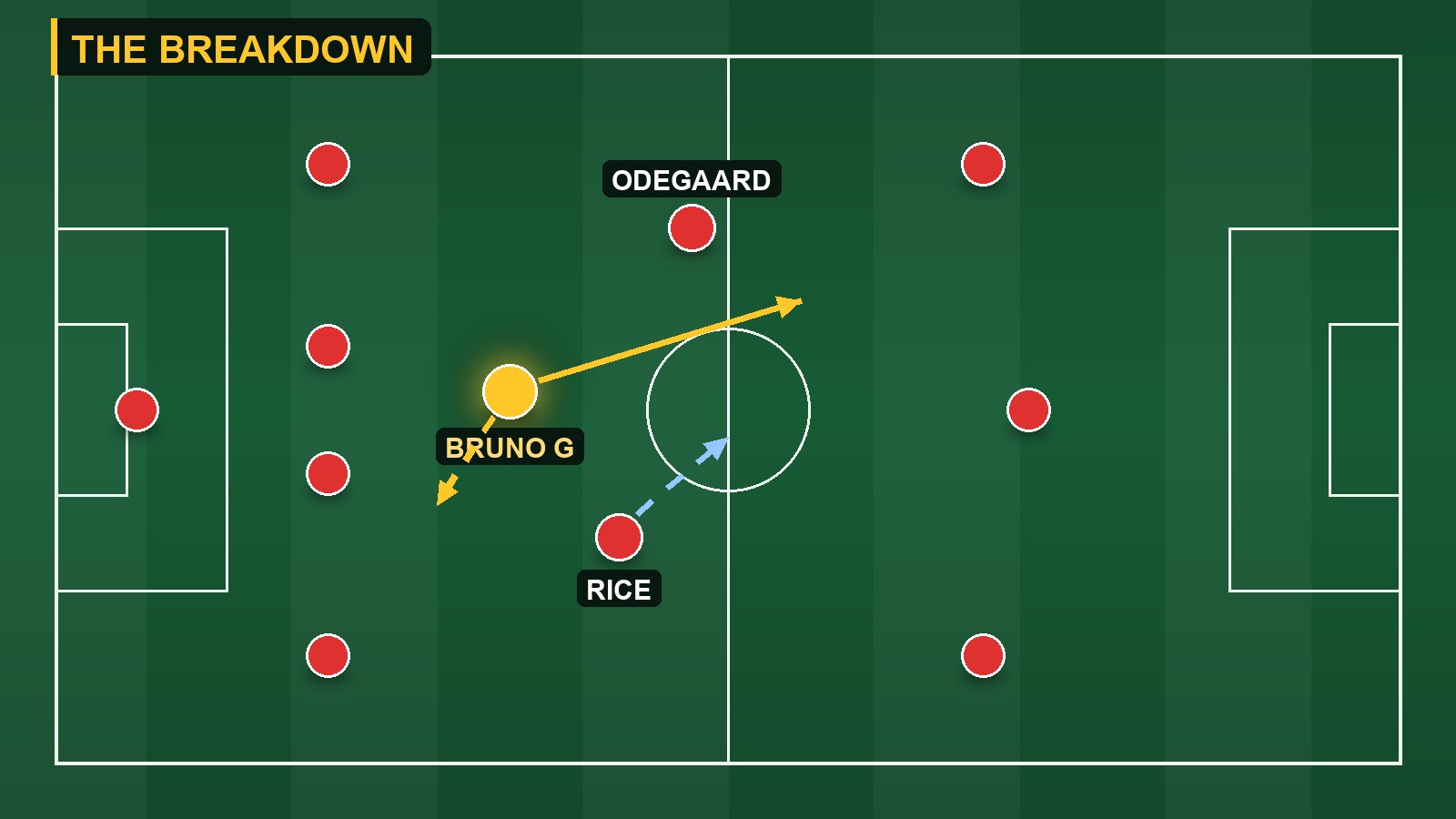
Put the two halves together and the plan stops being mysterious. Arteta is not buying a position; both of Bruno's natural homes are already owned, by a £105m eight and a £51m six. He is buying two things the title run proved he lacks, and neither of them is a ten, because Eze already covers the ten. First, end-product from deeper: Bruno's 9 goals and 5 league assists came from midfield proper, not the creator's slot, and that is production Arsenal's eight-and-six structure has never generated on its own, the kind that keeps arriving even when the man in the ten is a deputy. Second, interchangeability: with Bruno alongside Rice and Zubimendi, Arteta owns three midfielders who can each hold two posts, which means the shape can move mid-match, four-three-three into a double pivot into a box, without a substitution and without the game waiting for the bench. There is a third tell, subtler: Budapest's final half-hour. Leads in finals are not held by defending; they are held by midfielders who own the ball, win the cheap fouls, and make the clock an ally, and that is the precise game Bruno has played since he was holding Newcastle's fort at the six. The plan the bid reveals is a midfield that can be three different midfields between kickoff and full-time, that never again spends a title run praying for one man's knee, and that never again spends the last half-hour of a final unable to make the game slow down.
So how does he actually play? The four deployments
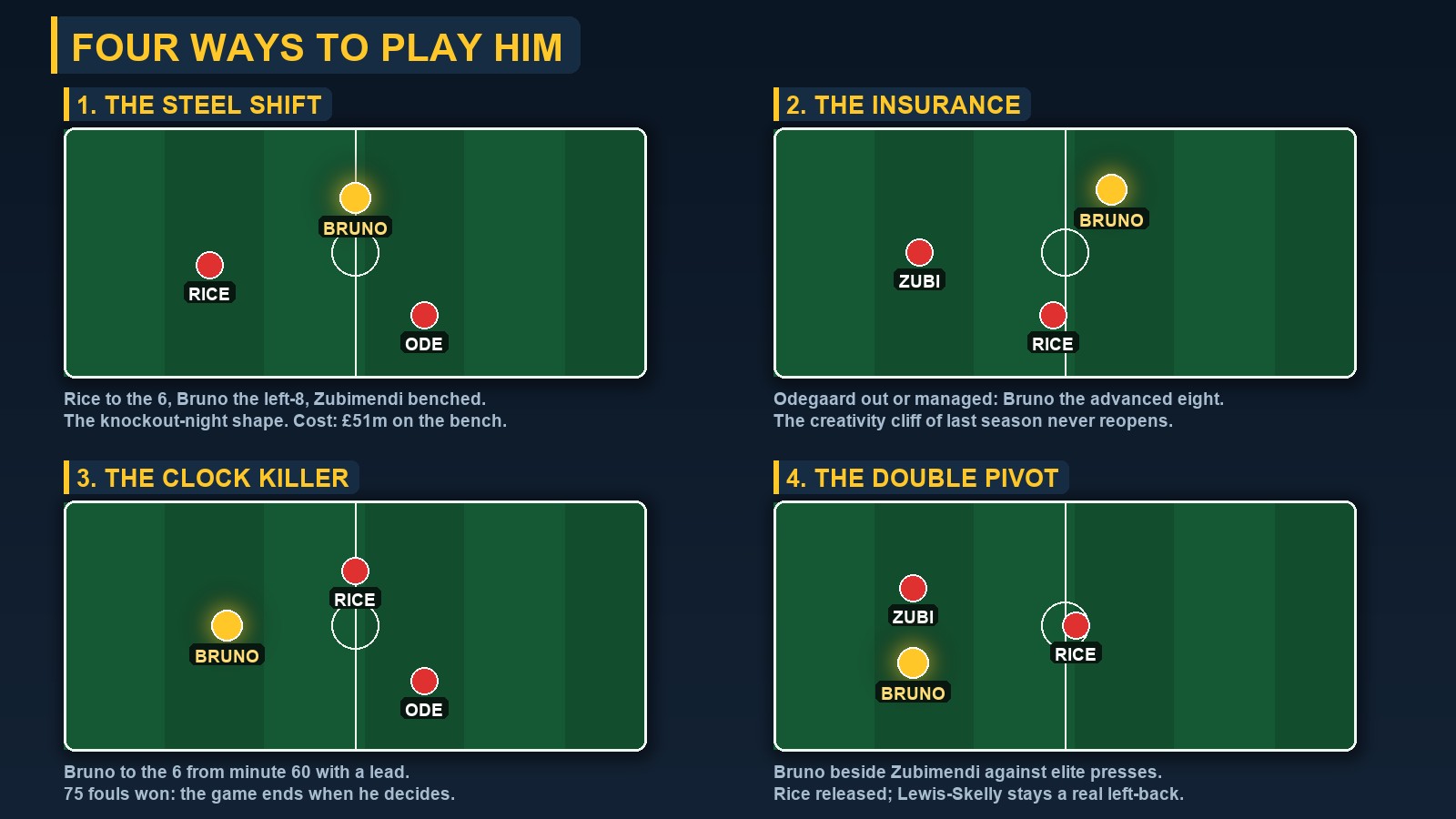
One: the steel shift. Rice drops to the 6 he grew up in, Bruno takes the left-8, and Zubimendi, the £51m metronome, watches from the bench. This is the shape for the nights Arsenal meet a press like PSG's, maximum carry and contact through midfield, and its cost is political as much as tactical: benching last season's ever-present for the biggest games is how dressing rooms learn who the manager really trusts.
Two: the insurance. Odegaard absent or minutes-managed, Bruno steps into the advanced right-eight, the role his 2025-26 season at Newcastle proves is his best, with Zubimendi and Rice unchanged behind him. Last season this scenario meant Eze improvising or Merino filling in; next season it means nine-goal production walks in without the structure noticing. This is the deployment the Odegaard medical file demands.
Three: the clock killer. From minute sixty with a lead, Bruno replaces the ten entirely and drops beside or into the 6, and Arsenal stop playing football and start administering it. Seventy-five fouls won a season is a weapon with no equivalent in the current squad, and Budapest's final half-hour is exactly the wound it treats. Expect this one in every tight match by October.
Four: the double pivot. Bruno alongside Zubimendi at the base against elite presses, Rice released permanently higher, while the shape Budapest actually trusted was the three, with Lewis-Skelly carrying the left-eight shirt. Bruno in this configuration is not a new idea; he is an £80m replacement for a teenager who did not lose that final alone.
Watch the opening month for which of the four appears first, because that is Arteta answering, in team-sheet form, which of last season's scars hurt most.
The numbers, because claims are cheap
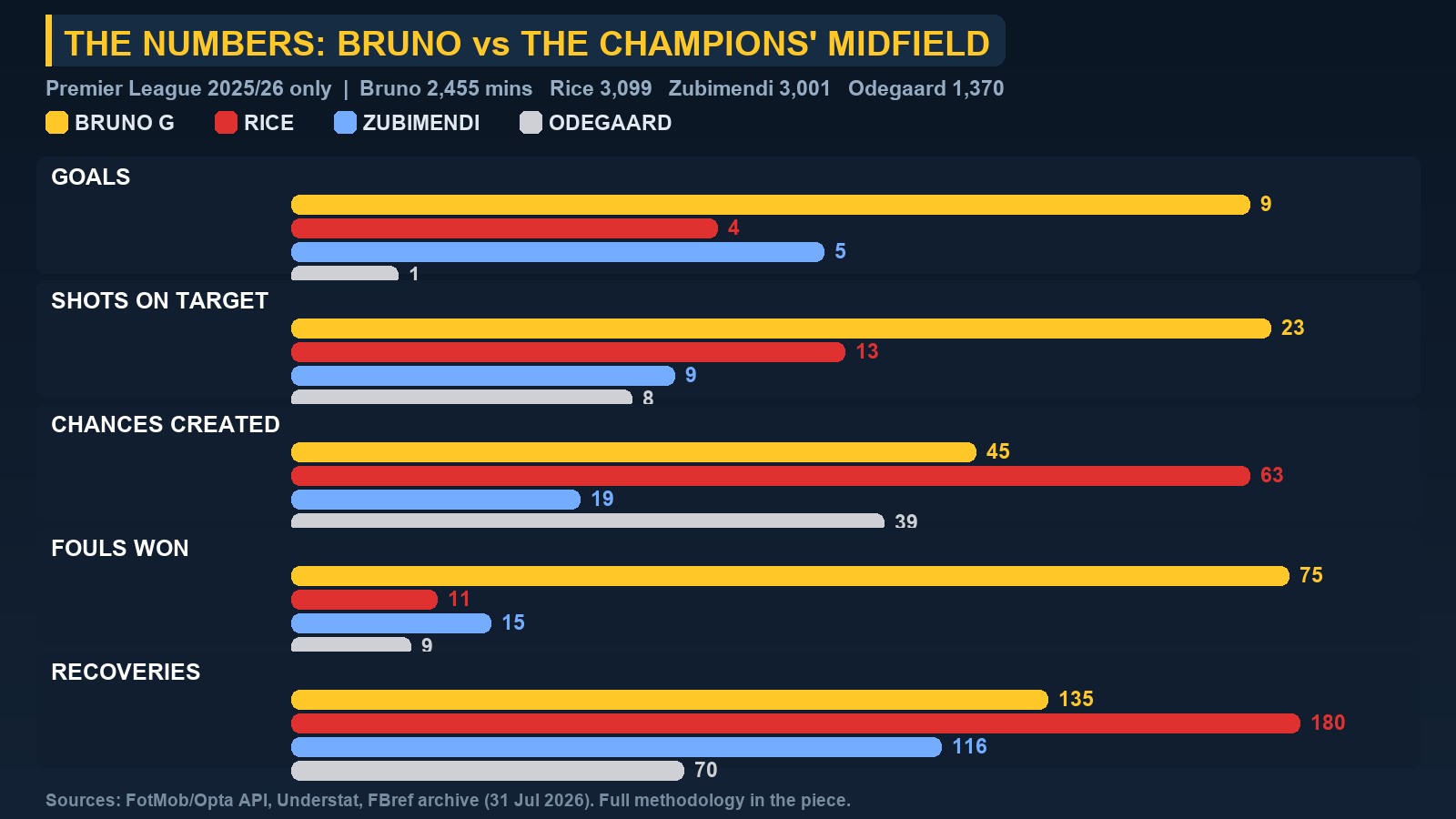
Run the thesis against the verified season data and it holds, with one honest wrinkle. Production from deeper: Bruno scored 9 league goals from 23 shots on target; Arsenal's entire midfield trio managed 10 goals and 30 on target between them, with Rice's 13 the best of it. The Budapest claim, that Bruno makes the clock an ally, stops being poetry in one row: he won 75 fouls last season. Rice, Zubimendi and Odegaard combined won 35. No signing in this window changes how the last half-hour of a tight match feels more than that number. Creation splits the argument properly: Rice's 63 chances created and 17 big chances were the champions' real creative engine while Odegaard healed, and Bruno's 45 do not dethrone him, they flank him. And the wrinkle the desk will not hide: Bruno won 50.5% of his duels last season against Rice's 60.2 and Zubimendi's 59.8, the price of being the man who volunteers for every contested ball in the most crowded yards on the pitch. The numbers say what the prose said, minus the romance: he adds goals, fouls and carries from midfield proper, he does not add duel dominance, and nobody buys him for that.
Data: Premier League 2025/26 only, pulled 31 July 2026 from the FotMob/Opta API and Understat, cross-checked against FBref archive copies; xG models never mixed; minutes vary by up to 40 across providers and are quoted from FotMob/Opta. Metrics we could not verify to this standard, including progressive carries, are excluded rather than estimated.
The losers, named
Every £80m signing is a redistribution of someone else's minutes. Zubimendi is the quiet loser: his clean, undisputed six becomes shared custody the moment Bruno's drop-rotation is real, a season after he was signed to own it. Merino, one of the names Arteta leaned on through the Ødegaard absences, slides from rotation to emergency. Eze keeps the ten-deputy shirt, but discovers the club's answer to the long-term succession question is a Brazilian midfielder, not the man who put five past Spurs. The Nwaneri loan already showed which way the wind blows for one academy path. And Lewis-Skelly, who started the Champions League final as the left-sided eight at nineteen, is the most direct casualty of all: Bruno plays where he just proved he belongs, and the left-eight shirt he was handed in Budapest. And Rice is affected most interestingly of all: a third tactical identity in as many seasons, which is either the making of his peak years or one reinvention too many. Squads are zero-sum. The champions just have more expensive zeroes.
And Newcastle?
Losing your captain and Player of the Year a fortnight before kickoff is not a sale, it is surgery. The £5m gap between bid and ask reads like a dignity clause. Watch the sequencing: if Newcastle move for a midfielder before anything is announced, believe the deal. If they do not, the ask is real, and the desk will break down the successor the day one appears.
Reporting attributed to the outlets below; transfer coverage on this desk separates what is reported from what is announced, and says which is which.
Correction, 3 August 2026: an earlier version of this piece described Lewis-Skelly's Champions League final role as part of a two-man pivot. Arsenal's midfield in the final was a three: Rice, Odegaard and Lewis-Skelly as the left-sided eight, with Zubimendi on the bench, per the confirmed line-ups. The text and board graphics have been updated.